Sorry this one was a little late - we work Tuesday through Saturday at the Museum, and I plain forgot that it was Friday yesterday!
La Belle's long voyage didn't just include France and Texas. The ship, artifacts, and people involved came from all over Europe. Here's a map showing some of those global connections. The light blue markers show the origins of some of the artifacts, the dark blue show some of the other people and places, and the red markers represent parts of the voyage itself. Do you wonder about something on this map, or something that's not on the map? Send an email or post a comment and we'll try to get your question answered and the map updated post-haste!
Zoom in and move the map around - some of those markers are pretty close together.
If archaeologists excavated your house, what would a map of the objects and people look like? Where does your stuff come from? Tell us in the comments!
View La Belle - Global Connections in a larger map
Saturday, April 24, 2010


Friday, April 16, 2010
Ceramics
Just like a modern house or boat, La Salle's crew had lots of things that needed to go in cups or pots. On Belle, they used ceramics to store liquids, including medicines, water, and wine.
We've got a lot of ceramics on Belle (we've got a lot of everything on Belle), but they're mostly of only a couple types (again, like many things on Belle, we've got lots of examples of the same sort of artifacts).
There's tin-glazed ceramic, called "faience". It was probably used for medicine.

There's also lots of Saintonge, a green glazed earthenware.

Saintonge is a common discovery across Europe in medieval archaeological sites, but becomes less common in sites dating after the medieval period. It might be a little surprising to see this sort of ceramic on a ship from the 17th century (long after the medieval period) - except that La Belle left from the Saintonge region of France, meaning that the people who were purchasing supplies for the expedition were buying their containers locally.
We also have a collection of pipe stems, made out of clay. Since they're clay, they're considered ceramic and included in with this group of artifacts. Most of the pipe stems are on exhibit at museums.
Like every sub-collection from La Belle, I've been going through piece by piece, counting what's in every bag. This is verified against what the excavation and conservation database suggests should be in the collection. The database is corrected if there are problems. Since analysis of the ceramics has been done, I also compared the collection to the analyst's spreadsheet, making sure all the artifacts were in the right order and had the right numbers. Finally, each piece of ceramic is rebagged into the proper archival bags and a new label is printed for it. Since labeling is the last step, a bag with a new-style label tells everyone who sees it that the contents are correct, and are properly represented in the database (you can see one of these new labels in the picture of Saintonge up above). Finally, the database is sent back to Austin to be reconciled with the copies kept at the Texas Historical Commission.
From the distribution of the artifacts in the wreck site, researchers can learn where in the ship different types of ceramic were kept and presumably used. Ceramics used to hold food supplies would likely be stored in a different area of the ship than ceramics used for medicine. If someone went through your house, what could they learn about your life from where you keep your jars, cans, and medicines?
We've got a lot of ceramics on Belle (we've got a lot of everything on Belle), but they're mostly of only a couple types (again, like many things on Belle, we've got lots of examples of the same sort of artifacts).
There's tin-glazed ceramic, called "faience". It was probably used for medicine.

This is a faience "apothecary" jar. As you can tell, it was found broken.
There's also lots of Saintonge, a green glazed earthenware.
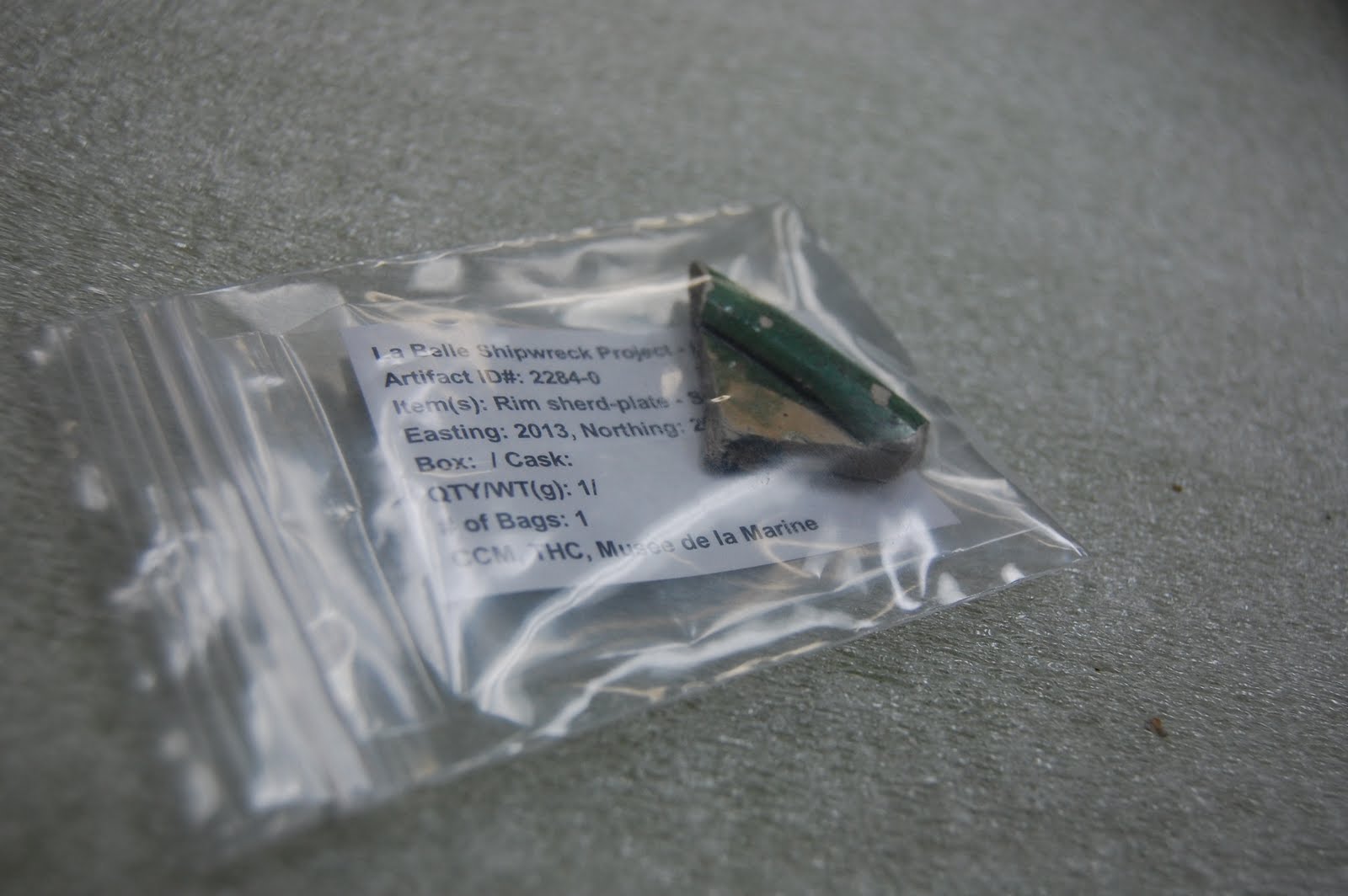
Here's a piece of Saintonge. It's only a fragment (archaeologists call them "sherds"), but that's much more common than full vessels in the collection!
Saintonge is a common discovery across Europe in medieval archaeological sites, but becomes less common in sites dating after the medieval period. It might be a little surprising to see this sort of ceramic on a ship from the 17th century (long after the medieval period) - except that La Belle left from the Saintonge region of France, meaning that the people who were purchasing supplies for the expedition were buying their containers locally.
We also have a collection of pipe stems, made out of clay. Since they're clay, they're considered ceramic and included in with this group of artifacts. Most of the pipe stems are on exhibit at museums.
Like every sub-collection from La Belle, I've been going through piece by piece, counting what's in every bag. This is verified against what the excavation and conservation database suggests should be in the collection. The database is corrected if there are problems. Since analysis of the ceramics has been done, I also compared the collection to the analyst's spreadsheet, making sure all the artifacts were in the right order and had the right numbers. Finally, each piece of ceramic is rebagged into the proper archival bags and a new label is printed for it. Since labeling is the last step, a bag with a new-style label tells everyone who sees it that the contents are correct, and are properly represented in the database (you can see one of these new labels in the picture of Saintonge up above). Finally, the database is sent back to Austin to be reconciled with the copies kept at the Texas Historical Commission.
From the distribution of the artifacts in the wreck site, researchers can learn where in the ship different types of ceramic were kept and presumably used. Ceramics used to hold food supplies would likely be stored in a different area of the ship than ceramics used for medicine. If someone went through your house, what could they learn about your life from where you keep your jars, cans, and medicines?
Friday, April 9, 2010
Lead Shot
La Salle carried a lot of shot with him. And because of the recovery of Belle, we've got a lot of shot here at the museum.
How much?
Well, we don't quite know yet...

...But it's a lot. We have about 1700 "lots" of shot, ranging from a single ball weighing 0.1 grams (that's about 1/25th of a penny's weight) up to a lot weighing over 50 kilograms (110 pounds) and with thousands of balls.
A big (perhaps the biggest) portion of the 2010 La Belle inventory is a complete count and weighing of the ship's lead shot collection.
The shot was used for the ship's cannons, muskets, and pistols, and comes in all shapes and sizes. There's more small bird shot than you can shake a stick at.

We suspect there's about two and a half tons in this part of the collection, but we won't know for a few more days. First, the shot was put in order. Then, it was counted by hand. Once it was counted, it was all weighed. If the lot was too big to count by hand, we took a small sample, counted it, and weighed it. This gave us an average per-shot weight for that bag. Then the weight of the whole bag could be divided by the average, and that gave us a good count of the entire bag.
After all that is done, we can print out labels, one for each bag in the collection. Then the labels can be put with their artifacts, and the artifacts can be put in new bags.
This is a pretty time-consuming process, as it requires going through the entire collection several times, and lots of moving artifacts in and out of their bags. When it's done, however, the project will have a good idea how much shot La Belle was carrying, and where it was within the ship, possibly illuminating details of life on board and storage philosophies.
One big question involves the differing quality of shot on the ship. Some is well-made and very round. Other specimens would be hard-pressed to even fit in a musket, much less shoot well. One possibility is that the irregular shot was meant for larger ship's guns as anti-personnel ammunition. Another is that La Salle was defrauded by shot manufacturers, who mixed in garbage with their shot to save money.
If La Salle was headed to America peacefully, why did he need so much shot? If he was headed for war, why did he bring families and so many trade objects? Post your answers in the comments!
How much?
Well, we don't quite know yet...

These are two of our many trays of shot. Off to the right, there are shelves full of more shot. We've been working to get these counted, weighed, and rebagged.
...But it's a lot. We have about 1700 "lots" of shot, ranging from a single ball weighing 0.1 grams (that's about 1/25th of a penny's weight) up to a lot weighing over 50 kilograms (110 pounds) and with thousands of balls.
A big (perhaps the biggest) portion of the 2010 La Belle inventory is a complete count and weighing of the ship's lead shot collection.
The shot was used for the ship's cannons, muskets, and pistols, and comes in all shapes and sizes. There's more small bird shot than you can shake a stick at.

This is only one of the lots of birdshot. There are several thousand pieces here.
We suspect there's about two and a half tons in this part of the collection, but we won't know for a few more days. First, the shot was put in order. Then, it was counted by hand. Once it was counted, it was all weighed. If the lot was too big to count by hand, we took a small sample, counted it, and weighed it. This gave us an average per-shot weight for that bag. Then the weight of the whole bag could be divided by the average, and that gave us a good count of the entire bag.
After all that is done, we can print out labels, one for each bag in the collection. Then the labels can be put with their artifacts, and the artifacts can be put in new bags.
This is a pretty time-consuming process, as it requires going through the entire collection several times, and lots of moving artifacts in and out of their bags. When it's done, however, the project will have a good idea how much shot La Belle was carrying, and where it was within the ship, possibly illuminating details of life on board and storage philosophies.
One big question involves the differing quality of shot on the ship. Some is well-made and very round. Other specimens would be hard-pressed to even fit in a musket, much less shoot well. One possibility is that the irregular shot was meant for larger ship's guns as anti-personnel ammunition. Another is that La Salle was defrauded by shot manufacturers, who mixed in garbage with their shot to save money.
If La Salle was headed to America peacefully, why did he need so much shot? If he was headed for war, why did he bring families and so many trade objects? Post your answers in the comments!
Friday, April 2, 2010
An introduction to the project.
Between the 17th century and 2010, there have been hundreds of people associated with La Belle. I'm only one of them. My name is Eric, and I'm doing the La Belle inventory for the Corpus Christi Museum and the Texas Historical Commission. I'm also going to be writing this blog about the process.
At the museum, we have somewhere just under two million artifacts from La Belle, ranging from big pieces of iron down to small fragments of insects. Over the next year, I'm going to be counting them a category at a time. Archaeology involves a lot of paperwork, and one of the big jobs is to make sure all the paperwork matches each other, and most importantly, matches the actual object. If an object is a piece of Saintonge ceramic (you'll hear all about ceramics pretty soon), all those databases better say that it's a piece of Saintonge - and the ID numbers need to match. I'll be going into the process as we go along.
This blog's going to be a running summary of the inventory project. It'll have entries about the big categories of artifacts, as well as some about particularly interesting artifacts from the collection.
Of course, if you want to see any of these artifacts for yourself, you'll have to come by the Corpus Christi Museum or any of the other La Salle Odyssey museums sometime.
At the museum, we have somewhere just under two million artifacts from La Belle, ranging from big pieces of iron down to small fragments of insects. Over the next year, I'm going to be counting them a category at a time. Archaeology involves a lot of paperwork, and one of the big jobs is to make sure all the paperwork matches each other, and most importantly, matches the actual object. If an object is a piece of Saintonge ceramic (you'll hear all about ceramics pretty soon), all those databases better say that it's a piece of Saintonge - and the ID numbers need to match. I'll be going into the process as we go along.
This blog's going to be a running summary of the inventory project. It'll have entries about the big categories of artifacts, as well as some about particularly interesting artifacts from the collection.
Of course, if you want to see any of these artifacts for yourself, you'll have to come by the Corpus Christi Museum or any of the other La Salle Odyssey museums sometime.
Thursday, April 1, 2010
A little background...
In February, 1686, a lonely French ship was battered by a strong winter storm in Texas.
It had made the long journey from France with Rene-Robert Cavelier, Sieur de la Salle, the famed explorer. He and his crew had come to the New World to establish a colony at the mouth of the Mississippi River. Unfortunately, knowledge of America's geography was limited, and the expedition landed in Texas, hundreds of miles from the Mississippi. Convinced their river was somewhere very near, the La Salle colonists had established a small fort as a base settlement. Misfortune had visited the expedition since they landed - their supply ship sank and men died of disease. Food and water were scarce.
Finally, in February, their remaining ship, La Belle, sank. This was devastating for the new colony. They no longer had any possibility of escape by sea, nor any way to inform their families or country what had happened. La Salle decided to make the very long trek overland from South Texas to Quebec, where there were other French citizens. He was murdered by his own men somewhere in East Texas. Only a few people made it to Quebec, and then back to France. The rest died of disease, starvation, or Indian attacks.

In 1995, Texas Historical Commission archaeologists found La Belle in the mud under Matagorda Bay. The THC raised the money needed and conducted the huge excavation project to recover almost two million artifacts which were then conserved by the Conservation Research Laboratory at Texas A&M University. Most of the conserved artifacts are here at the Corpus Christi Museum of Science and History. Because the La Belle was a military ship, the artifacts actually belong to the nation of France and the Musee National de la Marine. An international treaty allows the THC to preserve the collection for the public.
They represent, in many cases, the last link to the men and women of the La Salle expedition. The artifacts are the last chances for these stories to be told. Perhaps this is an overly-romantic way to look at pieces of pottery or lumps of lead. But all of them have a story, and they were all made or used by someone who died very far from home, in a new and strange land.
Over the next year, we're going to be counting, weighing and sorting these artifacts - and you can come along. We'll be posting updates and pictures of the artifacts we're working on, and letting you see a part of the archaeological process most people never see - all the curatorial work that goes on behind the scenes to preserve the stories we hold in trust.
It had made the long journey from France with Rene-Robert Cavelier, Sieur de la Salle, the famed explorer. He and his crew had come to the New World to establish a colony at the mouth of the Mississippi River. Unfortunately, knowledge of America's geography was limited, and the expedition landed in Texas, hundreds of miles from the Mississippi. Convinced their river was somewhere very near, the La Salle colonists had established a small fort as a base settlement. Misfortune had visited the expedition since they landed - their supply ship sank and men died of disease. Food and water were scarce.
Finally, in February, their remaining ship, La Belle, sank. This was devastating for the new colony. They no longer had any possibility of escape by sea, nor any way to inform their families or country what had happened. La Salle decided to make the very long trek overland from South Texas to Quebec, where there were other French citizens. He was murdered by his own men somewhere in East Texas. Only a few people made it to Quebec, and then back to France. The rest died of disease, starvation, or Indian attacks.

This painting shows the La Salle expedition. La Belle is on the left. The supply ship, L'Aimable, is sinking to the right, and Le Joly - the remaining ship - sailed back to France shortly after.
In 1995, Texas Historical Commission archaeologists found La Belle in the mud under Matagorda Bay. The THC raised the money needed and conducted the huge excavation project to recover almost two million artifacts which were then conserved by the Conservation Research Laboratory at Texas A&M University. Most of the conserved artifacts are here at the Corpus Christi Museum of Science and History. Because the La Belle was a military ship, the artifacts actually belong to the nation of France and the Musee National de la Marine. An international treaty allows the THC to preserve the collection for the public.
They represent, in many cases, the last link to the men and women of the La Salle expedition. The artifacts are the last chances for these stories to be told. Perhaps this is an overly-romantic way to look at pieces of pottery or lumps of lead. But all of them have a story, and they were all made or used by someone who died very far from home, in a new and strange land.
Over the next year, we're going to be counting, weighing and sorting these artifacts - and you can come along. We'll be posting updates and pictures of the artifacts we're working on, and letting you see a part of the archaeological process most people never see - all the curatorial work that goes on behind the scenes to preserve the stories we hold in trust.
Subscribe to:
Posts (Atom)


 Posts
Posts

